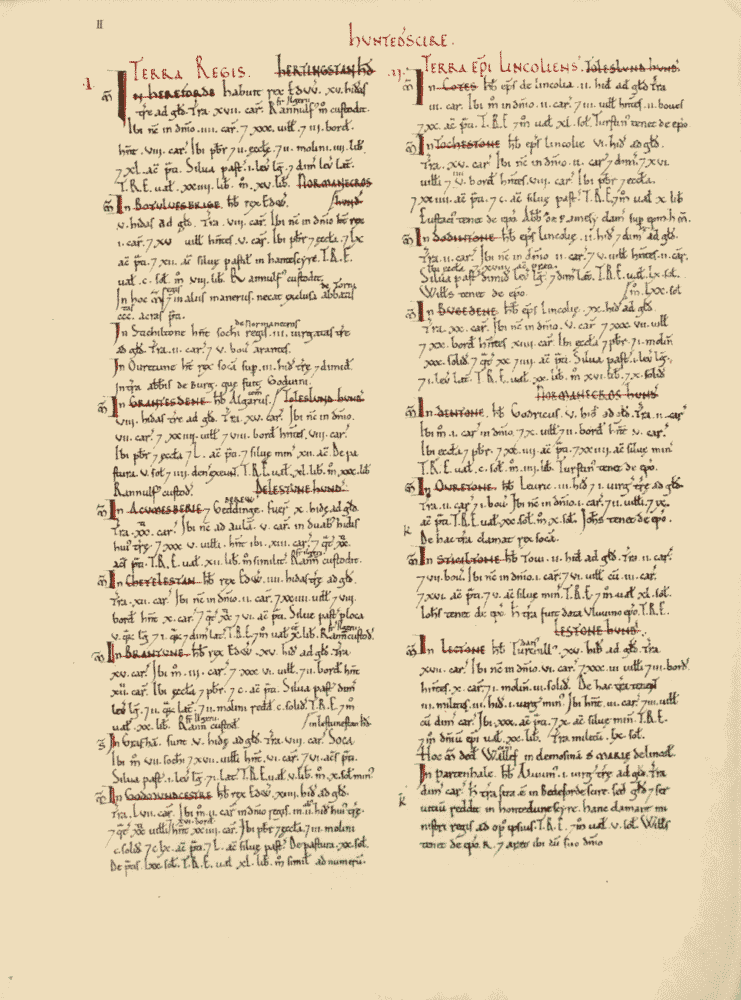
‘Domesday Book entry about the BIshop’s residence at Bugden’
Origins of Buckden as a Bishop’s Residence
From the building of the first bishop’s residence in the eleventh century Buckden became a place of religious, social and sometimes state importance. Many bishops, royalty and notable people visited and left their mark. Up to the time of the Reformation the line of the Bishops of Lincoln included two saints, three cardinals and six chancellors.
Bishop Hugh of Lincoln and Miraculous Events
The highly regarded Bishop Hugh of Lincoln visited the house he had built at Buckden several times in the twelfth century and two incidents, both regarded as miraculous by his contemporaries, took place there. His funeral procession stopped at Buckden on the way from London to Lincoln to a great outbreak of grief and claims of miraculous cures. Bishop Hugh was later canonized and is commemorated at Buckden by the dedication of the church, which includes a stained-glass window, and a sculpture in the forecourt.
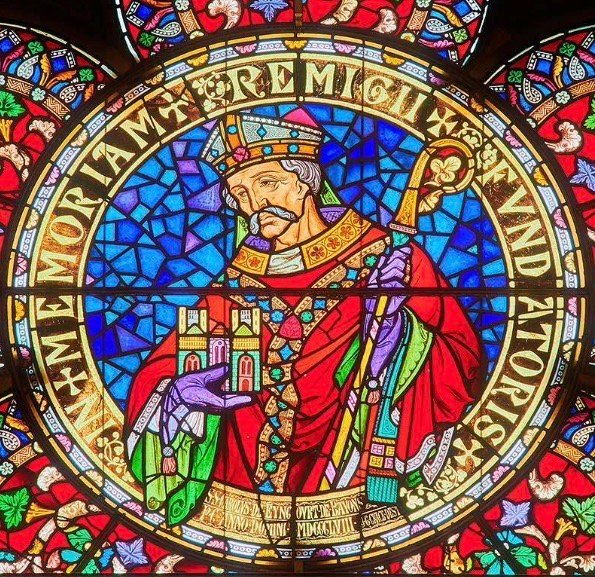
An image of the window at Lincoln Cathedral dedicated to St Hugh of Lincoln.
Robert Grosseteste and Early Royal Visitors
Another early and outstanding Bishop of Lincoln and statesman, Robert Grosseteste, contributed a Great Hall to the Palace complex. He died at Buckden after an illness that lasted three months. His death and the events that followed at Buckden were recorded by the famous medieval chronicler Matthew Paris. Before the major upgrading of the palace in the late C15, royalty who visited Buckden included Henry II in 1248, Edward I in 1291 and Richard II in 1483. After the upgrading came Margaret Beaufort, mother of Henry VII in 1501, Thomas Wolsey, as Bishop of Lincoln, in 1514 and James I in 1619.
Catherine of Aragon and the King’s Lodging
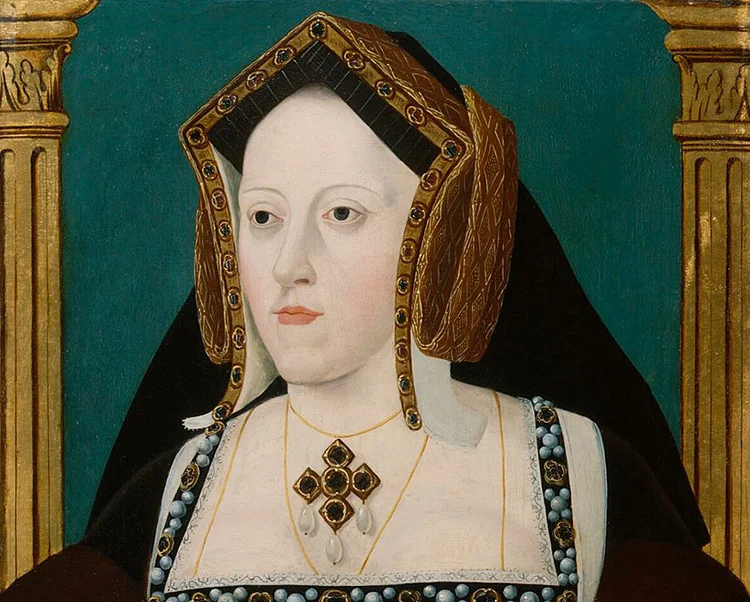
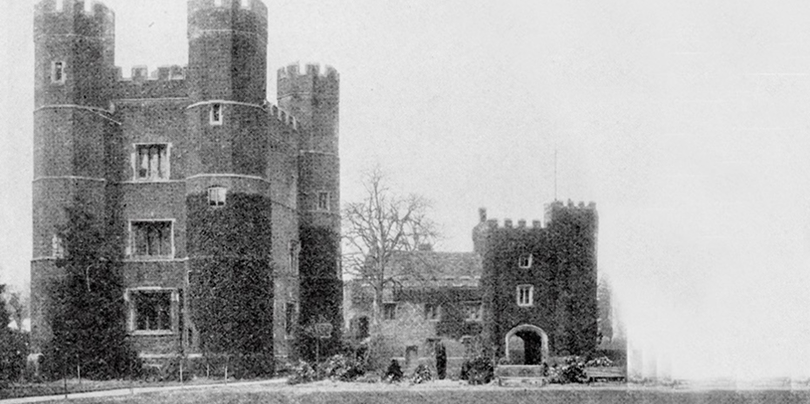
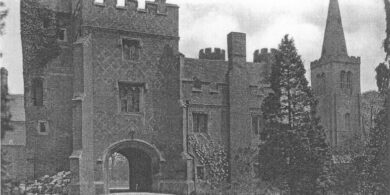
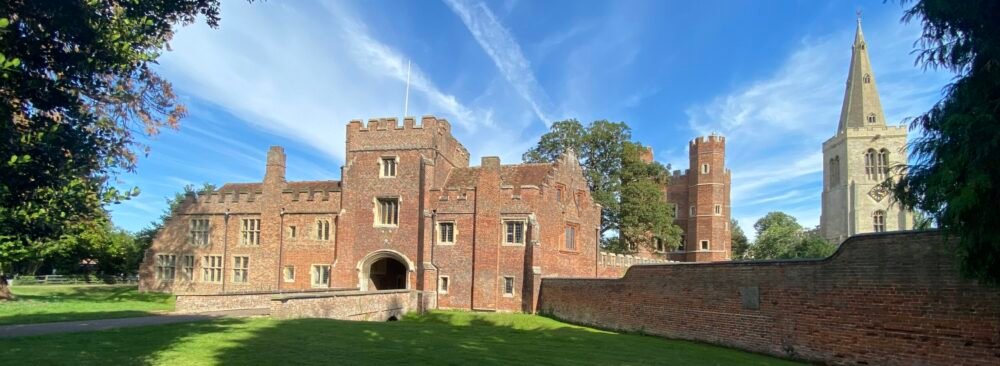
Probably the most important royal visitor to Buckden Palace was Catherine of Aragon who was sent there by order of Henry VIII after the annulment of their marriage. She stayed at the Palace from July 1533 until May 1534 when she was moved to Kimbolton, where she lived the rest of her life as a semi-recluse. Records exist of her popularity with the villagers and events that took place. From this ‘lodging’ of his first queen the Tower became known as the ‘King’s Lodging’. Henry VIII himself with his fifth wife, Catherine Howard, visited shortly after in 1541.
The Reformation and the Changing Diocese
The Reformation saw a reduction in the size of the Diocese of Lincoln with the creation of the dioceses of Oxford and Peterborough. With a smaller diocese and fewer residences, the Anglican bishops tended to find Buckden even more important to them. Bishop Cooper (1571–1584) spent most of his time and performed most of his episcopal duties there.
The Witches of Warboys and a Shakespearean Controversy
Under Bishop Wickham the notorious Witches of Warboys’ trial was held at Buckden Palace in 1592. On a lighter note, Bishop John Williams (1625–1642) and several of his distinguished guests were punished and/or fined by the Archbishop of Canterbury for desecrating the Sabbath in September 1631 with a performance of A Midsummer Night’s Dream that had been staged in the grounds of the Palace, starting at 10 p.m. on the Saturday but not finishing until the early hours of the Sunday.
Seventeenth-Century Bishops and Samuel Pepys
Samuel Pepys was very friendly with Bishop Fuller (appointed 1667) and probably visited. The successors of Fuller greatly favoured Buckden as a residence and Bishop Barlow (1675–1691) spent so much of his time there that he became known as the ‘Bishop of Buckden who never saw Lincoln’. He died there and is buried in the parish church.
The Prince Regent’s Visit
Another royal visitor to Buckden Palace was the Prince Regent, later George IV, who spent a night there in 1814 on his way from staying at Belvoir Castle. He gave an interview here to the officers of the French prisoners-of-war detained at Norman Cross.
Buckden During the World Wars
During the First World War the house was used as a convalescent hospital and during the Second World War as a home to evacuees from the London blitz and subsequently as a hostel for agricultural workers.
The Arrival of the Claretian Missionaries
After nearly one hundred years in private hands from 1869–1956, the social significance of Buckden Towers was renewed with the arrival of the present owners, the Claretian Missionaries and the return of the Catholic faith to the site. One of four foundations in England of an Order founded by Saint Anthony Mary Claret in Vich, Spain in 1849, the Claretians are devoted to spreading the Kingdom of God on Earth. By this they understand working together with other people to improve society, regardless of people’s creed. Over the years they have welcomed and worked with people of other Christian backgrounds and other religious faiths. In their work throughout the world their priorities have been in education and healthcare.
Restoration and the Junior Seminary
A considerable amount of work was undertaken to make the buildings habitable and the new chapel and community hall were erected in 1958 and 1962. It had initially been intended by the Claretians to have a junior seminary on the site and in September 1957, 31 boys arrived at the boarding school. Known as St Hugh’s College, the seminary prepared Catholic boys between the ages of twelve and eighteen with a classical education for eventual membership of the fast-growing Order. The Junior Seminary closed in 1965 and as a Catholic parish had been created in 1969 the St. Claret Centre was opened in 1974 for conferences and spiritual retreats.
The Claretians in the Local Community
The Claretians are now a vital part of the daily life of Buckden and surrounding villages. The Centre welcomes visitors, both local and from far afield, especially young people. Assisted by qualified lay people, they design and lead events aimed at religious formation and growth. Many adults come for religious retreats and conferences, both individually and in groups, staying in both the Tower and the refurbished Inner Gatehouse. St Stephen’s Hall, the community hall, is an extremely popular facility for independent local groups not concerned with the Congregation, as is the house which is currently in use as a conference centre.
The Friends of Buckden Towers
In 1976, on the initiative of Fr. Michael Mahon, the Superior and Parish Priest, a group of local residents met and subsequently formed a Trust under the title of the ‘Friends of Buckden Towers’. In May 1977 they became a Registered Charity the objects of which, as set out in the Trust Deed, are: ‘To preserve or by making monetary grants to assist in the preservation for the benefit of the townspeople of Buckden in the County of Cambridgeshire and of the nation at large of the group of buildings situate at Buckden collectively called or known as Buckden Towers or Buckden Palace together with the land belonging thereto.’
Continuing Preservation and Queen Katherine’s Garden
The Friends continue to welcome members and arrange fundraising and social events. As well as fundraising for vital repairs, the Friends provide volunteers to physically help with the work and act as guides on visitor tours. The Friends have also supported the owners of the property in the creation of the knot garden, known as Queen Katherine’s Garden, which was started in 1994 and involved work with offenders on community programmes.