
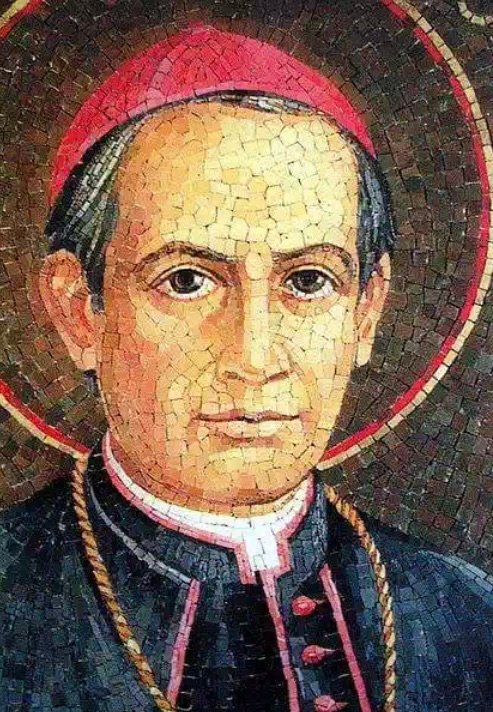
St Anthony Mary Claret – Founder of the Claretian Missionaries
St Anthony Mary Claret, often called the “spiritual father of Cuba,” was a remarkable missionary priest whose life combined deep faith with tireless action. He was a religious founder, social reformer, archbishop, writer and publisher, royal chaplain, and, in his final years, an exile for the faith.
Born in Spain, Claret first worked as a weaver and designer in the textile mills of Barcelona. During this time, he taught himself Latin and printing—skills that would later shape his ministry as both preacher and publisher.
Ordained a priest at the age of 28, ill health prevented him from joining religious life as he had hoped, but he soon became one of Spain’s most powerful and popular preachers.
For ten years, he travelled widely, preaching parish missions and retreats. His message centred on the Eucharist and a deep devotion to the Immaculate Heart of Mary. It was said that his rosary was never out of his hand. At the age of 42, he founded the congregation of missionaries now known as the Claretians.
Claret was later appointed Archbishop of Santiago de Cuba, where he worked tirelessly to renew the life of the Church. He preached constantly, heard confessions for long hours, and defended the dignity of all people, including enslaved Africans. His efforts brought strong opposition. He survived an assassination attempt—by a man whose release from prison he had previously secured—and later ensured his attacker’s life was spared.
Deeply concerned for the poor, Claret promoted practical solutions such as small family farms to improve livelihoods and independence. He also wrote on these themes, alongside many spiritual works.
Recalled to Spain, he served as chaplain to the queen under strict conditions that allowed him to remain focused on his priestly ministry. Following political upheaval, he went into exile in France, where he continued preaching to the Spanish community.
Throughout his life, Claret made great use of the written word. He founded a major Catholic publishing initiative and wrote or distributed over 200 books and pamphlets, seeing the media of his time as a vital tool for evangelisation.
At the First Vatican Council, he was a strong and respected voice in defence of the faith. Despite facing misunderstanding, slander, and numerous threats to his life, he remained steadfast in his mission.
He died in exile in 1870 near the border of Spain. Today, he is remembered not only for his extraordinary energy and courage, but for his deep trust in God and his unwavering commitment to spreading the Gospel. His life reminds us that following Christ often involves sacrifice, but also brings the grace to persevere. Like St Anthony Mary Claret, we are all called to live our faith with conviction and to share God’s love in the world around us.