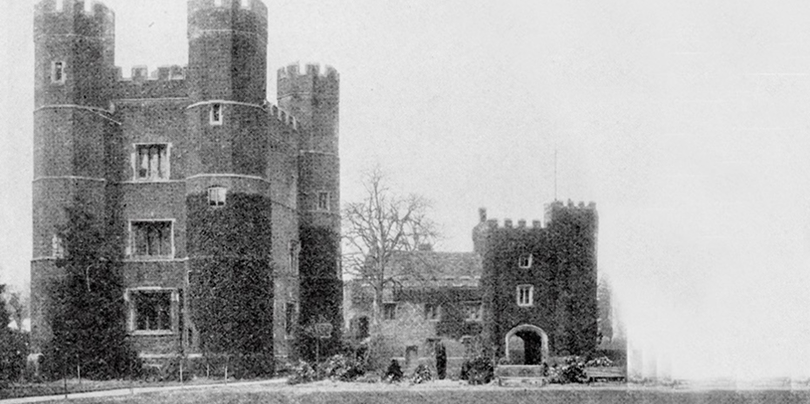

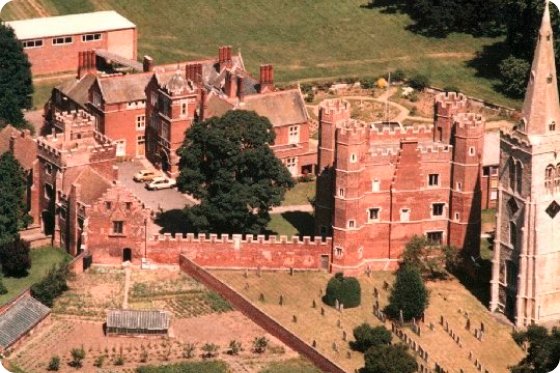
| ‘Buckden Towers’
Buckden Towers’ Facilities and Grounds Today
Buckden Towers is situated at the heart of the village of Buckden, bounded to the west by the High Street, formerly the Great North Road, and to the south by St Mary’s Church and Church Street, which continues as Mill Road towards the River Ouse. These two roads form the principal streets in Buckden. The north and east boundaries adjoin the modest rear gardens of residential properties on St Hugh’s Road and the large well treed rear gardens of properties on Silver Street. The site is enclosed by walls and a tree belt and has an air of quiet calm that contrasts with the relative busyness of the High Street.
The buildings and structures are all concentrated in the southwest corner of the site. The outer brick wall of the palace dominates the junction of High Street and Church Street; over 3 metres in height it extends approximately 116 metres on High Street and 70 metres on Church Street, terminating at the church boundary. The Outer Gatehouse, which has an embattled parapet, enables pedestrian access to the site from the High Street. There is a gated vehicular entrance situated towards the north end of the boundary wall. A small 19″ century, red brick single storey lodge with an overgrown garden is situated beside the Outer Gatehouse. A Stable Block now converted into three dwellings adjoins the boundary wall on High Street and has a window that perforates the boundary wall.
The Outer Court
The Outer Gatehouse entrance opens into the outer court, a green space that is crossed by a broad path leading directly to the imposing Inner Gatehouse. The outer court is bounded to the south by a 3- 4-metre-high stepped brick wall attached to the Inner Gatehouse. This wall separates the outer court from a walled enclosure to the south containing the Knot Garden and an area of former allotments. A drive from the vehicular entrance leads to the main house, and thereby to the inner court, with an access to the car park immediately to the north and a second drive passing to the rear of the Outer Gatehouse providing access to the Stable Block. In front of the Inner Gatehouse is a shallow, grassed moat crossed by a bridge with brick parapet walls. Most of the outer court is laid to lawn, punctuated by specimen trees, a cypress, hollies and a row of clipped yew parallel to the site boundary.
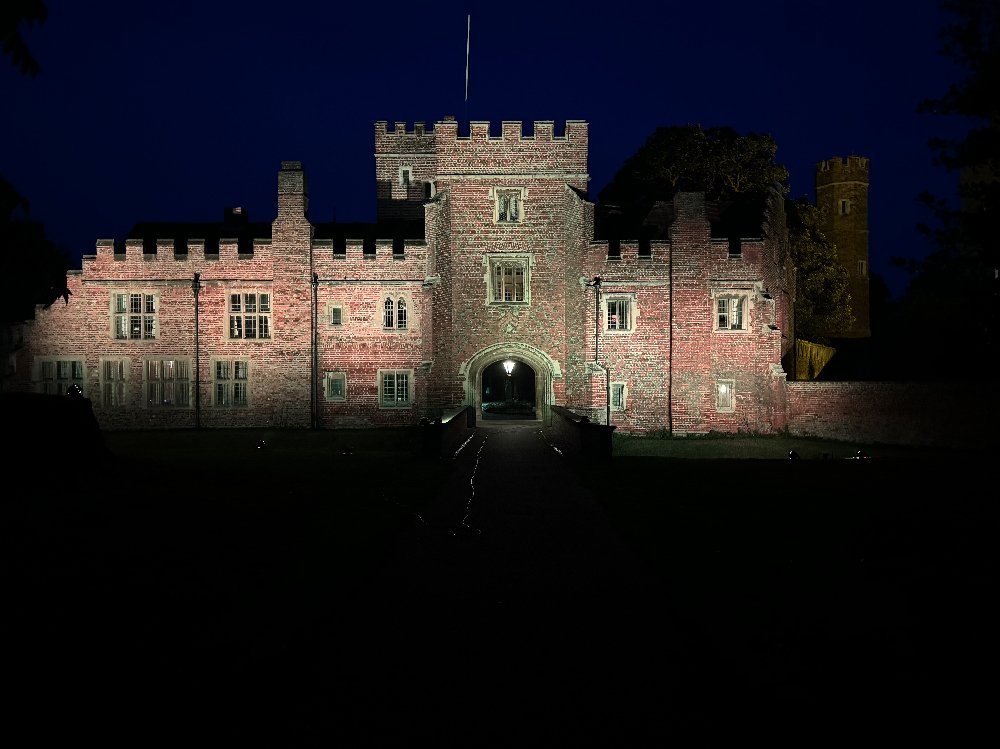
| A view of Buckden Towers in Huntingdonshire
The Inner Court
Beneath the arch of the Inner Gatehouse lies the inner court which is bounded by the main house, St Hugh’s Church and the Tower. The church is set back and linked each side to the house and tower by covered walkways, and the Tower is linked to the Inner Gatehouse by a crenelated wall with a raised walkway. The Tower, closely juxtaposed to the church spire of St Mary’s, dominates the space, while the principal elevation of the main house is offset with the principal entrance to the house at an oblique angle to the Inner Gatehouse entrance. Opposite the Inner Gatehouse entrance is a modest statue of St Hugh with a swan set within a small planting bed. The bed forms the centre of a large paved space within lawns, with flagged paths leading to the church and to entrances in the gatehouse accommodation. There are narrow planting beds beside the house and Inner Gatehouse with planted tubs located across the court to prevent vehicular access beyond the main entrance to the house.
Openings in the covered walkways either side of the church lead to grassed spaces defined by a low stone wall incorporating sections of balustrade. Within these spaces the ground slopes away from the house and tower towards the park. The space to the rear of the tower is separated from the church and churchyard by a section of
wall and a length of railings.
Queen Katharine’s Knot Garden
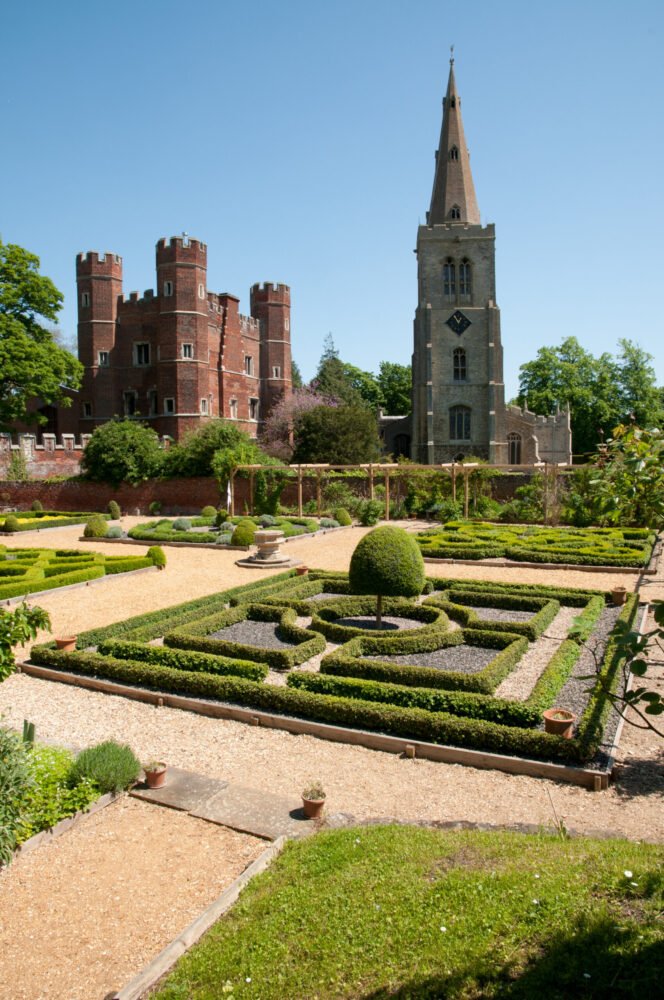
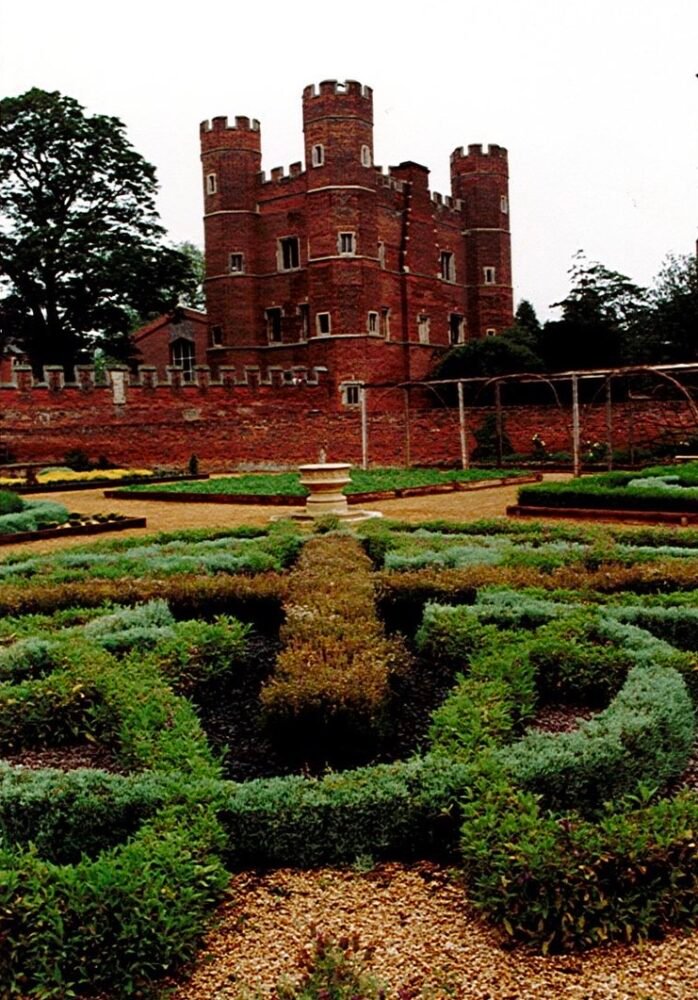
| ‘The Knot Garden, Buckden Towers’
The knot garden is entered by a gateway from the outer court. It comprises a stone paved terrace beside the Inner Gatehouse with steps down to gravelled paths between the timber edged knot beds. There are four principal beds around a central fountain with a stone plinth and two smaller beds planted with heraldic designs. An arbored walk forms the southern and part of the eastern boundary, backed by yew hedging forming a boundary between the knot garden and former allotment areas. There is a raised viewing mount in the southwestern corner of the garden. The allotments, enclosed by the brick boundary wall on Church Street and adjacent to the gardens of the Stable Block cottages, are in use.
The Car Park
The tarmac car park provides parking for approximately 50 cars close to the vehicular entrance and to St Stephen’s Hall. The Hall is situated north of the main house, set approximately .45 meters below paved levels surrounding the house in a space enclosed by timber rail fencing.
The Little Park
The Hall and car park project into the area known as the Little Park that extends north and east around the building complex. The Little Park comprises a treed boundary bank and walk enclosing an area of parkland, with a linear lake parallel to the eastern boundary, an orchard, nuttery and lime walk. The principal area of parkland comprising grass with scattered parkland trees has been subdivided with post and wire fencing to create a large enclosure north of the buildings and two smaller enclosures east of the main house and St Stephen’s Hall. Access to the large enclosure is via a timber field gate beside the car park and there are timber stiles to enable pedestrian access between the enclosures and around the lake.
The majority of the parkland trees in the large enclosure are young established trees protected by timber boxes, the grassland having been grazed in recent years, with an old horse chestnut and lime tree situated towards the lake. The smaller enclosure nearer the
house contains two majestic veteran parkland trees, an oak and a plane tree, which make a major contribution to the character of the parkland and the setting of the historic buildings.
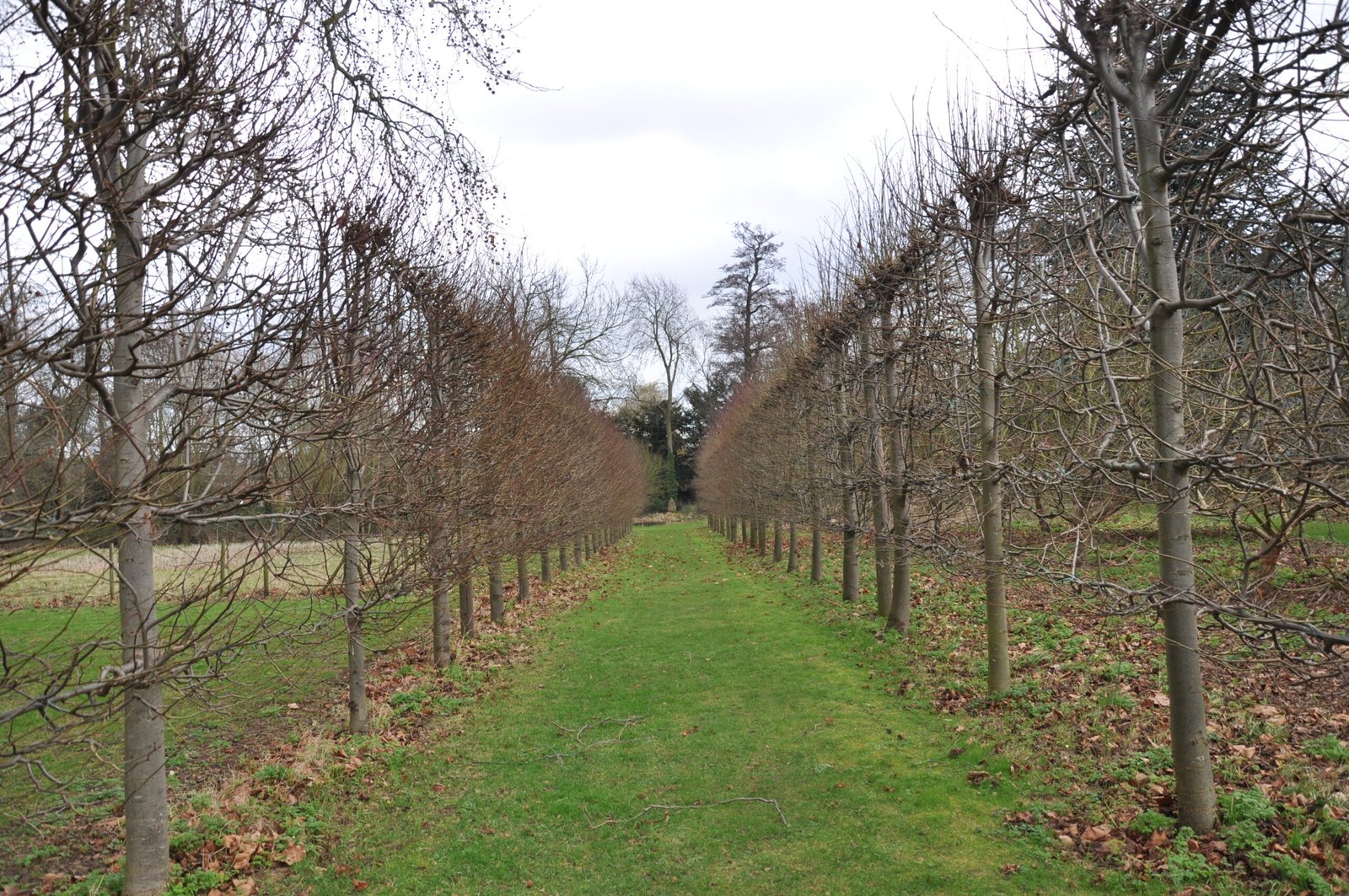
The Lime Walk, Orchard and Nuttery
A lime walk of established young pleached trees leads at right angles to the house from an opening in the low stone wall down to the lake. It separates the parkland to the north from a recently established orchard and nuttery to the south. The vista is terminated by a small modern statue of Jesus situated on the opposite bank of the lake. The orchard and nuttery include a young cedar and a small grove of oaks. A mown grass path traverses the orchard and links the space east of the house with the path around the lake. In the southeast corner of the orchard beside a derelict brick outbuilding close to the church is a storage area containing green waste and piles of stones.
The Boundary Walk
The boundary walk around the Little Park starts at grade from the northwest of the car park. t has a firm stoned surface throughout and continues to the southern end of the lake. There is a boundary bank varying in height between 1 and 1.2 metres to the outer side of the path along the western and northern boundaries. The bank is well covered with trees predominantly ash, lime, sycamore, yew and horse chestnut with much elm re-growth. The understorey comprises elder with symphoricarpus and ruscus with some wildflowers and areas with a dense carpet of ivy. The bank is quite uneven in places, possibly due to the rotting stumps of lost elm trees. A 1.8-metre-high chain link fence with concrete posts marks the boundary with the High Street and adjacent properties. This appears to have succeeded continuous bar parkland rail fencing, remnants of which remain in the undergrowth.
The boundary walk is separated from the parkland by a shallow ditch, remnant hedge and a post and wire fence. The width of separation from the parkland varies. Rounding the northeast corner of the site the boundary path rises gently to sit on the boundary bank close to the boundary and above the adjacent gardens. The boundary is characterised by mature horse chestnut trees with prolific self-sown trees on lower ground falling towards the lake. Near the southern end of the lake and adjacent to the statue the vegetation is more open with marginal species by the lake, lime trees beside the path, yew trees beside the boundary and some recently established yew hedging around the statue.
The Lake
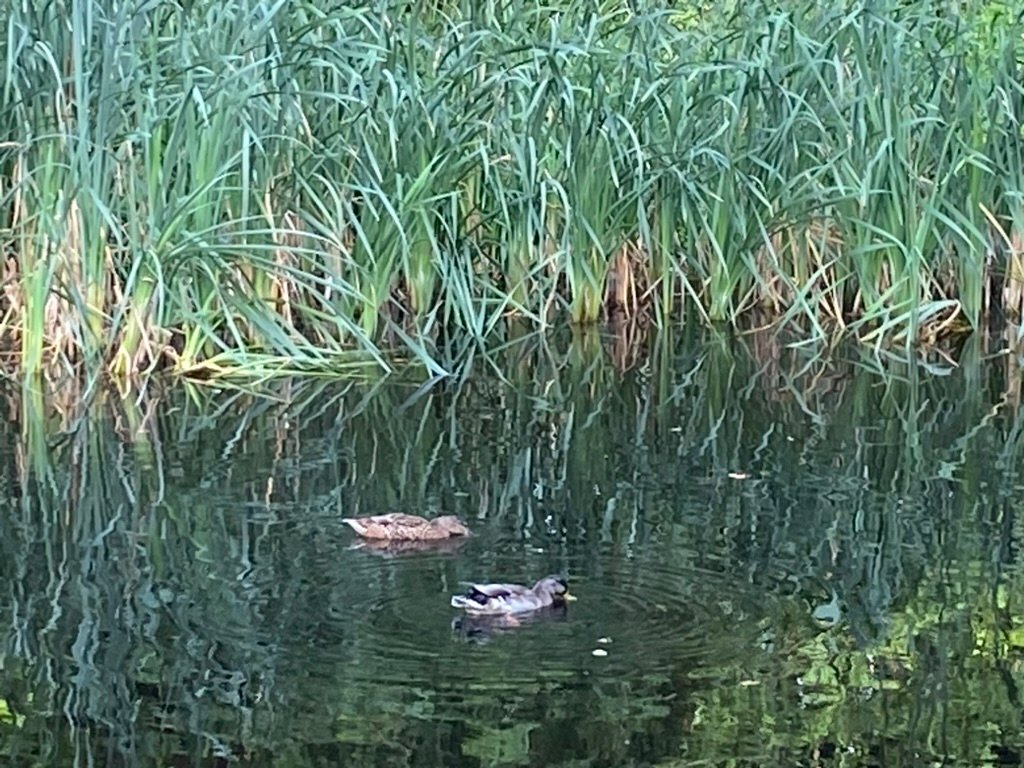
The lake appears to be shallow, is largely surrounded by trees, and due to the vegetation and limited elevation of surrounding ground there are few locations from which the water can be seen. The southern end of the lake curves round to encompass a small domed island covered with a dense growth of alder. At the northern end of the lake almost hidden by dense undergrowth is a mound rising to about 1.5 metres above surrounding ground levels. It is crowned by a huge veteran plane tree whose trunk is nearly 8 metres in girth and divides into four main stems at a height of approximately 4metres. Southeast of the mound and on the boundary with the parkland is an ancient evergreen oak with a broad hollow bole approximately 4 metres in diameter from which more recent growth arises as from a coppice stool.